

SEO consulting follows a structured process designed to improve a business’s revenue from organic search. The process has four stages: research and audit, strategy and roadmap, execution support, and measurement. Each stage produces specific deliverables. Each stage connects to a business outcome.
Most descriptions of the SEO consulting process show a clean graphic with three to five steps and leave it at that. That version is sanitized. The real process involves more detail, more collaboration, and more decisions than a flowchart can communicate. It also requires active participation from you, not just your consultant.
This page walks through what actually happens at each stage of an SEO consulting engagement: what your consultant does, what you receive, what your team is responsible for, and how each stage connects to revenue. It also covers what changes when the standard process does not apply and how long the entire engagement typically takes.
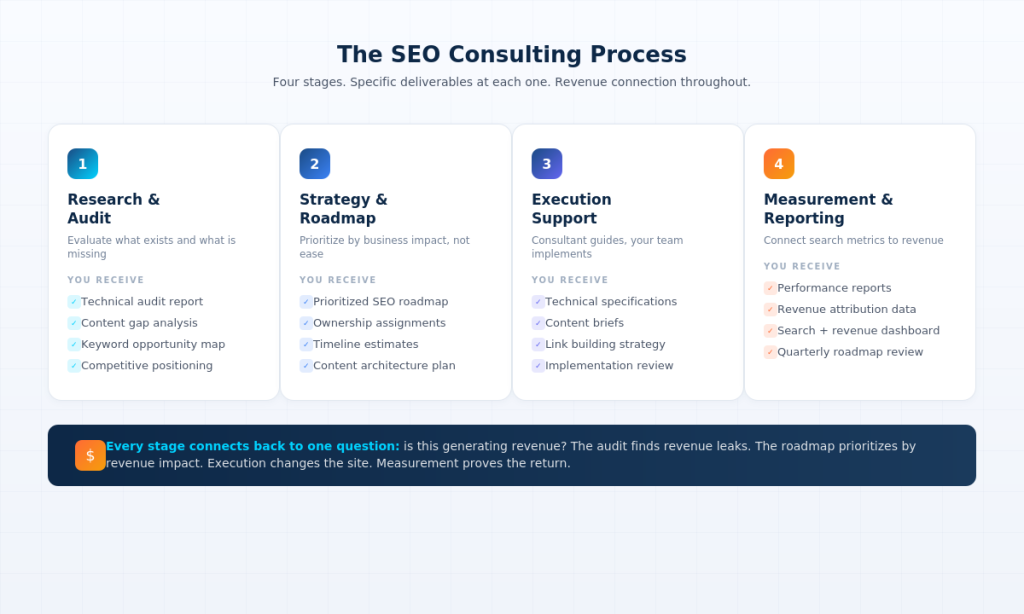
The process starts with research.
Stage 1: Research and Audit
The research and audit stage evaluates the current state of your website, your competitors, and your market. This is where an SEO consultant identifies what is working, what is broken, and what opportunities are being missed.
A technical SEO audit examines your site’s infrastructure: crawlability, indexation, page speed, mobile experience, internal linking, and structured data. If search engines struggle to access or understand your site, nothing else matters until those problems are fixed.
Content analysis follows the technical review. Your consultant evaluates existing pages for relevance, depth, keyword alignment, and gaps in topic coverage. Pages that rank for nothing, pages that compete with each other, and pages that exist without purpose all surface here.
The keyword research process identifies the queries your audience uses and maps them against your current visibility. The goal is not a list of high-volume keywords. The goal is a map of search intent that connects to your products, services, and revenue model.
Competitive analysis completes the picture. Your consultant examines who ranks for the queries you want, what content they produce, what backlink profiles they maintain, and where they leave gaps.
What you receive at this stage: A prioritized findings report covering technical issues (ranked by severity), content gaps, keyword opportunities, and competitive positioning. This report is the foundation for everything that follows.
How this connects to revenue: The audit identifies the specific problems preventing your site from capturing qualified traffic. A slow site, thin content, or missing keywords are not abstract SEO problems. They are revenue leaks. This stage quantifies them.
Your consultant leads this stage. Your team provides access to analytics, search console data, CMS credentials, and any prior SEO work. Without access, the audit is incomplete.
Once the audit identifies the problems, the next stage prioritizes the solutions.
Stage 2: Strategy and Roadmap
The strategy stage translates audit findings into a sequenced plan. This is where an SEO consultant decides what to fix first, what to build next, and what to defer.
Not every issue found in the audit carries the same weight. A missing H1 tag on a low-traffic page is not as urgent as a crawl error blocking your highest-converting product category. An SEO strategy sequences work by business impact, not by how easy something is to check off a list.
The primary output of this stage is an SEO roadmap. A roadmap typically includes three to six months of prioritized initiatives, organized by workstream: technical fixes, content development, and link acquisition. Each initiative includes an owner (your team or the consultant), a timeline, and a success metric.
Strategy development also defines the content architecture for your site. This includes which pages to create, which pages to consolidate, which pages to remove, and how they link together. Content architecture determines whether search engines understand your site as an authority on a topic or as a collection of unrelated pages.
What you receive at this stage: A documented SEO roadmap with sequenced priorities, ownership assignments, timeline estimates, and measurable targets. Not a generic recommendations deck. A working plan.
How this connects to revenue: The roadmap sequences work by expected revenue impact. High-value pages and high-severity technical issues come first. Low-impact items go to the back of the line. This prevents the common mistake of spending three months on cosmetic fixes while the real problems persist.
The strategy stage is collaborative. Your consultant builds the plan, but your team validates priorities against business context the consultant does not have: upcoming product launches, seasonal demand shifts, or internal resource constraints.
With the roadmap in place, execution begins.
Stage 3: Execution Support
Execution support is where the SEO consultant’s advisory role becomes most visible. The consultant guides, reviews, and quality-checks the work. Your team, your developers, or your content writers handle most of the implementation.
This distinction matters. An SEO consultant is not a freelance developer or a content writer. A consultant provides the specifications, reviews the output, and course-corrects when implementation drifts from the plan. Think of it as the difference between an architect and a general contractor. The architect designs the building and ensures it gets built correctly. The contractor does the building.
Execution typically covers three workstreams:
Technical fixes. Your developers implement changes based on the technical audit: fixing crawl errors, improving page speed, updating schema markup, resolving indexation problems, and restructuring internal links. Your consultant provides detailed specifications and reviews each implementation.
Content development. Your writers or content team create new pages, update existing content, and build topical depth based on the content strategy. Your consultant provides content briefs with target queries, entity requirements, word count guidance, and internal linking specifications. The consultant reviews drafts for SEO alignment before publication.
Link building. Link acquisition strengthens your site’s authority. Your consultant identifies target domains, outreach strategies, and content formats that attract links. Some consultants manage outreach directly. Others provide the strategy while your team or a specialist handles outreach.
What you receive at this stage: Technical specifications for developers, content briefs for writers, link building strategy documents, and ongoing review of implemented work. The consultant also flags when execution deviates from the roadmap.
How this connects to revenue: Execution directly changes your site. The pages that get built, the technical issues that get fixed, and the links that get earned determine whether your organic visibility improves or stalls. The consultant’s role is to ensure every change aligns with the revenue-prioritized roadmap from Stage 2.
This stage requires the most effort from your team. If you have limited internal resources, that constraint should surface during the strategy stage so the roadmap accounts for it.
Progress needs tracking. That is what the final stage covers.
Stage 4: Measurement and Reporting
Measurement connects the work to results. An SEO consultant tracks what changed, what improved, and what that improvement means for your business.
Standard SEO reporting covers rankings, organic traffic, click-through rates, and indexation health. These metrics tell you whether the work is producing search visibility. They do not, on their own, tell you whether that visibility is generating revenue.
Revenue-focused reporting goes further. It connects organic sessions to leads, pipeline, and closed revenue. This requires integration between your analytics platform, your CRM, and your attribution model. The goal is to answer a specific question: how much revenue did organic search generate this month, and how does that compare to what we spent on SEO consulting?
Your consultant reports on leading indicators (rankings, traffic, indexation) and lagging indicators (leads, pipeline, revenue). Leading indicators move first. Lagging indicators follow. If your consultant reports only on rankings and traffic, ask about the connection to measuring SEO ROI.
What you receive at this stage: Regular performance reports (monthly or bi-weekly), a dashboard covering both search metrics and revenue metrics, and a quarterly review of roadmap progress against targets.
How this connects to revenue: This is where the revenue connection stops being theoretical. Measurement determines whether the engagement is producing a return. If organic traffic grows but revenue stays flat, something is wrong with the traffic quality, the conversion path, or the attribution setup. Measurement identifies which one.
Reporting also informs the next cycle. SEO consulting is not a one-time project with a defined endpoint. The roadmap evolves as results come in, as competitors shift, and as your business priorities change.
Your Role in the Process
SEO consulting is not a service you buy and forget. It requires sustained participation from your side.
Your responsibilities include providing access to analytics, search console, and CMS platforms. They include connecting the consultant with your development team and your content team. They include reviewing and approving the roadmap. And they include allocating internal resources to implement the work the consultant specifies.
The engagements that produce the best results share a pattern: the client treats the SEO consultant as a strategic partner, not a vendor. That means attending regular check-ins, raising business context the consultant would not otherwise have, and making implementation a priority rather than letting technical specifications sit in a queue.
The engagements that stall share a different pattern: the client approves the roadmap, then never allocates the development time or content resources to execute it.
Your consultant handles the strategy, analysis, and oversight. You handle the execution, access, and organizational commitment. Both sides need to deliver for the engagement to work.
When the Process Changes
The four-stage model covers most SEO consulting engagements, but some situations change the sequence.
Site migration SEO compresses the timeline. If you are moving to a new domain, redesigning your site, or re-platforming your CMS, the SEO consultant’s primary role shifts to migration planning, redirect mapping, and post-launch monitoring. The standard audit-to-strategy sequence still applies, but everything operates on the migration timeline rather than a standard quarterly cadence.
Penalty recovery reorders the priorities. If your site has been hit by a manual action or an algorithmic penalty, the first stage focuses entirely on diagnosing the cause, removing or disavowing harmful links, and submitting reconsideration requests. Standard optimization work waits until the penalty is resolved.
Urgent technical problems also shift the process. If a site relaunch broke indexation, or a CMS update introduced critical crawl errors, the consultant addresses those issues before conducting a full audit. Stabilization comes first.
In all three cases, the process returns to the standard four-stage model once the immediate problem is resolved.
How Long SEO Consulting Takes
An SEO consulting engagement typically produces measurable results within three to six months. Significant revenue impact usually takes six to twelve months, depending on the starting condition of your site, your industry’s competitiveness, and the speed of implementation.
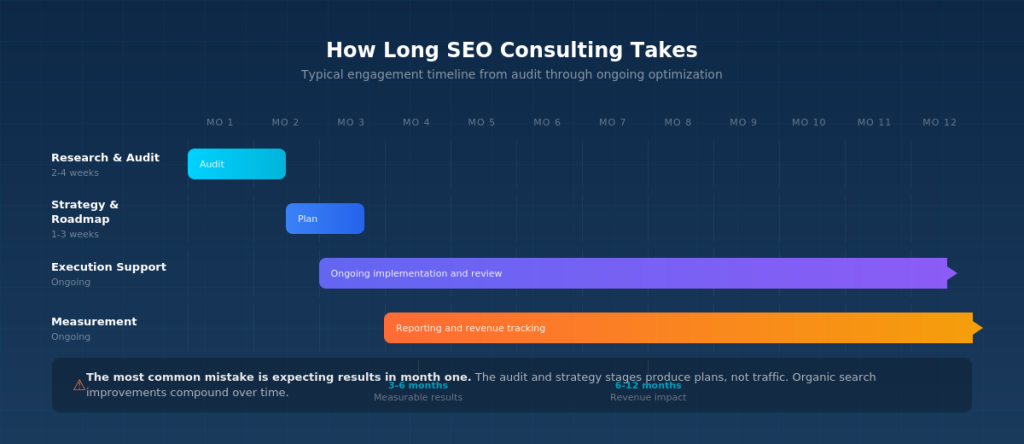
Stage 1 (research and audit) takes two to four weeks. Stage 2 (strategy and roadmap) takes one to three weeks. Stage 3 (execution) is ongoing and depends on the scope of work and your team’s implementation speed. Stage 4 (measurement) runs continuously alongside execution.
The most common mistake is expecting results in the first month. The audit and strategy stages produce plans, not traffic. Organic search improvements compound over time. A page published in month two may not rank competitively until month four or five. A technical fix implemented in month one may not fully register in search metrics until month three.
SEO consulting is not a quick fix. It is a structured process that builds organic revenue over time. If someone promises results in 30 days, that is a red flag worth investigating when you are learning how to hire an SEO consultant.
The process works when both sides commit to it. If you are evaluating whether SEO consulting fits your situation, the next step is understanding what it costs and how to assess whether the investment makes sense for your business.