An SEO audit is a systematic evaluation of your website’s technical infrastructure, content quality, keyword positioning, backlink profile, and competitive landscape. Its purpose is to identify what is preventing your site from generating the organic search revenue it should.
Most SEO audit services produce a list of errors ranked by severity. That is useful but incomplete. A useful audit goes further: it connects each finding to a business outcome, quantifies the revenue impact where possible, and sequences the fixes by how much they matter to your bottom line. The difference between a generic audit report and a revenue-focused audit is the difference between knowing you have 47 technical errors and knowing which three of those errors are costing you $12,000 a month in lost organic conversions.
This page covers what an SEO audit includes, what a consultant finds that automated tools miss, what happens after the audit, when an audit makes sense for your business, and how to evaluate audit quality before you commit. If you are evaluating SEO consulting as a service, the audit is where every engagement begins.
What an SEO Audit Covers
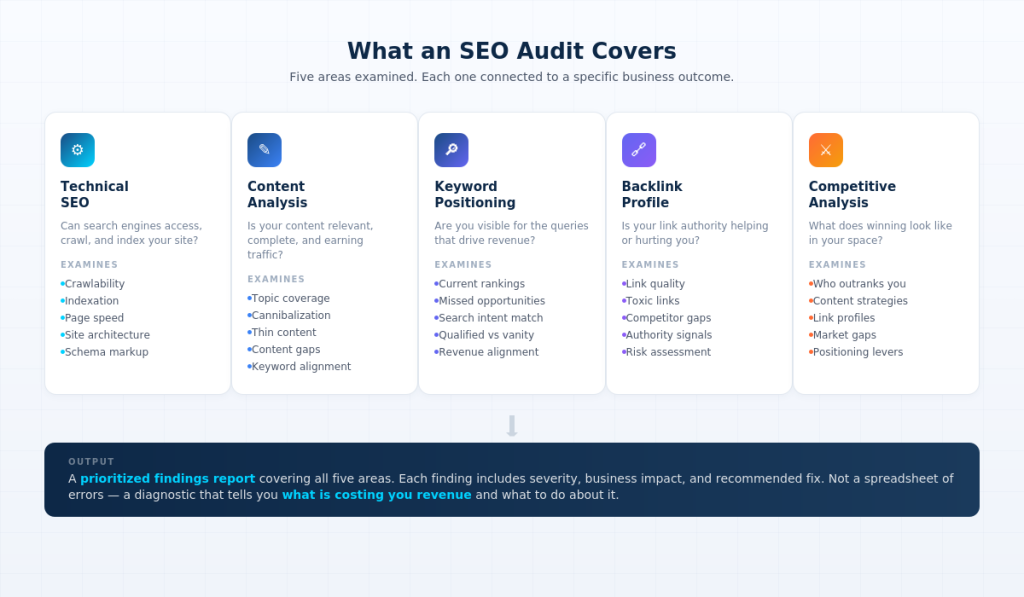
An SEO audit examines five areas. Each one connects to a specific business outcome.
Technical SEO
The technical audit evaluates whether search engines can access, crawl, and index your site correctly. This includes crawlability (can Google reach your pages), indexation (are your pages appearing in search results), page speed (how fast pages load for users and bots), mobile experience (responsive design, usability on devices), internal linking (how pages connect to each other), structured data (schema markup that helps search engines understand page content), and site architecture (URL structure, navigation, depth).
Technical problems are invisible to most business owners. A page that loads in six seconds instead of two does not look broken to a human. But it costs you rankings, and rankings cost you traffic, and traffic costs you revenue. The technical audit quantifies those costs.
Content Analysis
The content audit evaluates every page on your site for relevance, depth, keyword alignment, and topic coverage. It identifies pages that rank for nothing, pages that compete with each other for the same keywords (cannibalization), pages with thin or outdated content, and gaps where you have no content for queries your audience actively searches.
Content problems are the most common source of missed organic revenue. A site with 200 pages and no clear topic architecture will struggle to rank for anything competitive, regardless of how clean the technical foundation is.
Keyword Positioning
The keyword analysis maps your current visibility against the queries your audience uses. It identifies which keywords you rank for, which keywords you should rank for but do not, and which keywords drive qualified traffic versus vanity impressions. The keyword research process aligns search intent with your revenue model, not just search volume.
Backlink Profile
The backlink audit evaluates the quality, quantity, and risk profile of your inbound links. It identifies toxic links that could trigger penalties, gaps where competitors have links you do not, and opportunities to build authority through strategic link acquisition. A weak or risky backlink profile limits your site’s ability to compete for high-value keywords.
Competitive Analysis
The competitive audit examines who ranks for the queries you want, what content they produce, what backlink profiles they maintain, and where they leave gaps you can exploit. Competitive analysis turns the audit from an internal diagnostic into a market positioning tool. You cannot fix what is broken if you do not know what “winning” looks like in your space.
What you receive: A prioritized findings report covering all five areas. Each finding includes severity, business impact, and recommended fix. The report is not a spreadsheet of errors. It is a diagnostic document that tells you what is wrong, why it matters, and what to do about it.
What a Consultant Finds That Tools Miss
Automated SEO audit tools (Screaming Frog, Semrush, Ahrefs, SEOptimer) are useful for crawling a site and flagging technical errors. Every SEO consultant uses them. But a tool crawl is the starting point of an audit, not the audit itself.
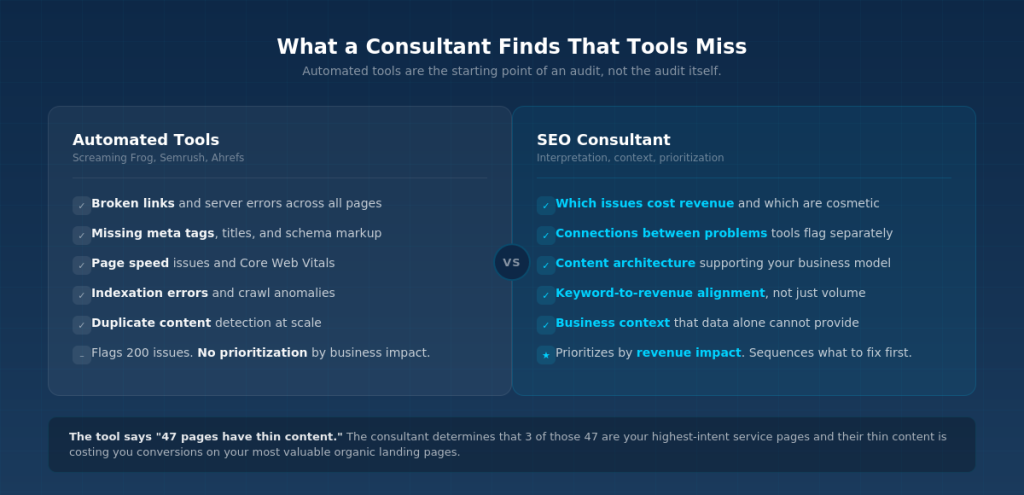
Here is what automated tools do well: they identify broken links, missing meta tags, slow pages, indexation errors, duplicate content, and schema problems. They do this at scale and they do it fast. For a site with 10,000 pages, no human is manually checking every title tag.
Here is what automated tools cannot do: they cannot tell you which of 200 flagged issues actually matter to your revenue. They cannot connect a crawl depth problem to a specific drop in conversions. They cannot evaluate whether your content architecture supports your business model or just fills space. They cannot assess whether your keyword targeting aligns with buyer intent or just generates impressions that never convert.
A consultant interprets the data. The tool says “47 pages have thin content.” The consultant determines that 3 of those 47 pages are your highest-intent service pages and their thin content is directly responsible for a 40% bounce rate on your most valuable organic landing pages. That distinction is where the value lies.
The consultant also identifies relationships between problems. A technical crawl might flag a site speed issue separately from an indexation issue separately from a content gap. A consultant recognizes that the site speed issue is caused by unoptimized images on your product pages, those same product pages have thin content, and the combination is why Google is not indexing them. Three separate tool flags. One connected problem. One prioritized fix.
If your site is small and your SEO needs are basic, an automated tool may be sufficient. If your site drives meaningful revenue from organic search, a consultant audit is the appropriate investment.
What Happens After the Audit
An audit without a plan is a document that sits in a folder. The value of an SEO audit is in what follows it.
After the audit, the findings feed directly into the strategy and roadmap stage. Your SEO consultant takes the prioritized findings and translates them into a sequenced action plan: what to fix first, what to build next, and what to defer. This is where an SEO audit becomes how SEO consulting works in practice.
The sequence matters. Not every finding carries the same weight. A missing canonical tag on a low-traffic blog post is not as urgent as a crawl error blocking your highest-converting product category. The SEO roadmap that follows the audit organizes work by revenue impact, not by ease of implementation.
The typical flow is: audit findings, prioritized recommendations, roadmap development, execution support, measurement. The audit is Stage 1 of a four-stage process. Businesses that treat the audit as an endpoint miss the point. The audit identifies the problems. The roadmap fixes them. Measurement confirms whether the fixes produced a return.
Some businesses commission an audit, receive the report, and implement the recommendations with their internal team. Others use the audit as the entry point into an ongoing consulting engagement. Both approaches work. The deciding factor is whether your team has the SEO expertise to execute the recommendations without ongoing guidance.
When You Need an SEO Audit (And When You Don’t)
An SEO audit makes sense when something is clearly not working and you do not know why. Specific signals include organic traffic declining without an obvious cause, a site redesign or migration that was not SEO-planned, content that generates impressions but not conversions, competitive pressure from businesses that consistently outrank you, or a new investment in SEO consulting where a baseline is needed.
An audit is the natural first step when you are hiring an SEO consultant. It establishes where you are before any strategy work begins.
An SEO audit does not make sense in every situation. If your site launched last month and has 10 pages, there is not enough data or structure to audit meaningfully. If you already know the problem (your site is on a terrible CMS, your content is thin, your domain is brand new), an audit will confirm what you already know and charge you for the confirmation. If your SEO challenges are purely resource-based (you know what to do, you just cannot execute), the audit is not the bottleneck.
Knowing when an audit adds value and when it does not is part of a consultant’s job. A good consultant will tell you if an audit is premature for your situation and recommend a different starting point.
How to Evaluate an SEO Audit
Not all SEO audits are created equal. The range in quality is significant, from a one-page automated report repackaged as a “professional audit” to a comprehensive diagnostic with revenue-connected findings and a clear action plan.
A useful SEO audit should include specific findings, not just categories. “Your site has technical issues” is not a finding. “Your site has 14 pages returning 404 errors, 3 of which receive over 500 organic visits per month, resulting in approximately X lost conversions” is a finding. The specificity is the value.
A useful audit prioritizes findings by business impact, not by quantity. A report with 200 issues and no hierarchy is less useful than a report with 20 issues ranked by revenue impact.
A useful audit includes recommended actions, not just diagnosis. Every finding should come with a clear next step: what to fix, how to fix it, and what the expected impact is.
Watch for SEO consultant red flags in the audit process itself: audits delivered within hours of receiving access (not enough time for real analysis), audits that consist entirely of automated tool output with no interpretation, audits with no prioritization, and audits that promise specific ranking outcomes as a result of fixing the flagged issues.
Understanding SEO consulting pricing helps set expectations for what a professional audit costs versus what an automated report generates for free.
The Starting Point
An SEO audit is the diagnostic foundation of every effective SEO consulting engagement. It identifies what is working, what is broken, and what is costing you revenue. The value is not in the list of issues. The value is in the interpretation, the prioritization, and the action plan that follows.
If your site should be generating more revenue from organic search than it currently does, the audit is where that conversation starts. The findings determine the strategy, the strategy determines the roadmap, and the roadmap connects to measuring SEO ROI in terms your business cares about.
The SEO consulting process begins with understanding what you have. An audit gives you that understanding.