

A disclosure before anything else: this comparison is written by an SEO consultant. That means there is an inherent perspective here. The goal is to be honest about that perspective rather than pretend it does not exist. Every comparison of SEO consultant vs agency that you find online is written by someone who sells one of the three models. None of them are neutral. The best you can ask for is transparency about where the bias sits and an honest attempt to present the trade-offs fairly.
The question of whether to hire an SEO consultant, an SEO agency, or an in-house SEO professional is not a question of which model is best. It is a question of which model fits your situation. Each one has genuine strengths and real limitations. The right answer depends on your business size, your internal resources, your budget, and what kind of problem you are trying to solve.
What follows is a comparison built around trade-offs and decision paths, not a pros-and-cons list. The goal is to help you make the decision based on your specific circumstances, not to convince you that one model is universally superior.
Three Models, Three Trade-Offs
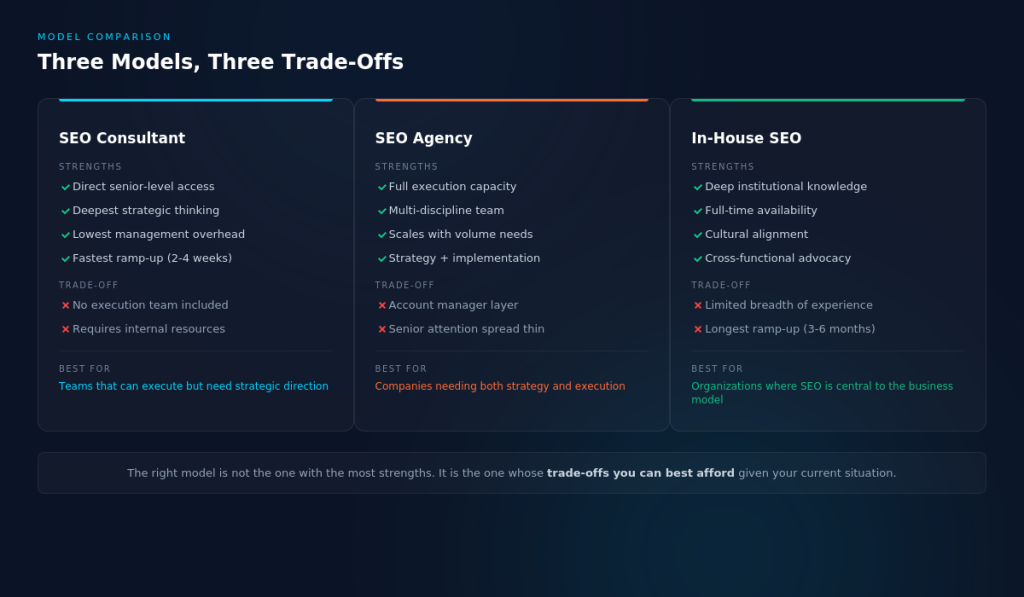
Each model gives you something the other two do not. Each one also costs you something the other two do not. Understanding those trade-offs is the foundation of a good decision.
The SEO Consultant
An SEO consultant is an independent strategist. You work directly with a senior-level professional who diagnoses your situation, builds a prioritized strategy, and provides ongoing guidance. There is no account manager between you and the person doing the thinking. The consultant sees your SEO program as a whole, identifies the highest-impact opportunities, and builds the roadmap.
The trade-off is execution capacity. A consultant typically does not come with a team of writers, developers, and link builders. The consultant provides the strategy and direction. Your team or your contractors handle the implementation. If you do not have internal resources to execute recommendations, a consultant alone will not get the work done.
Read this if you want to learn more about how SEO consulting works.
The SEO Agency
An SEO agency is a team. You get multiple specialists: strategists, writers, technical SEOs, link builders, and a project manager. The agency handles both strategy and execution. If you need 50 pieces of content produced in a quarter, an agency has the capacity to deliver that. If your site needs significant technical overhaul, the agency has developers who can implement the changes.
The trade-off is the account manager layer. In most agencies, your primary contact is not the person doing the strategic work. Your account manager coordinates the team, but the strategist working on your account may also be working on 10 or 15 other accounts. The strategic depth per client is often thinner than what a consultant provides because the agency model scales by distributing senior attention across many clients. You get execution breadth at the cost of strategic depth.
The In-House SEO Professional
An in-house SEO is a full-time employee. They know your business, your culture, your internal politics, and your product better than any external provider ever will. They attend your meetings, understand your roadmap priorities, and can advocate for SEO within your organization every day. The institutional knowledge an in-house SEO builds is difficult for an outside consultant or agency to match.
The trade-off is breadth of experience and external perspective. An in-house SEO works on one site, in one industry, facing one set of challenges. A consultant or agency professional works across multiple sites, industries, and problem types each year. That exposure creates pattern recognition and strategic range that a single-company role cannot replicate. In-house SEOs can also become isolated, missing industry shifts or new approaches because their world is limited to one organization.
Which Model Fits Your Situation
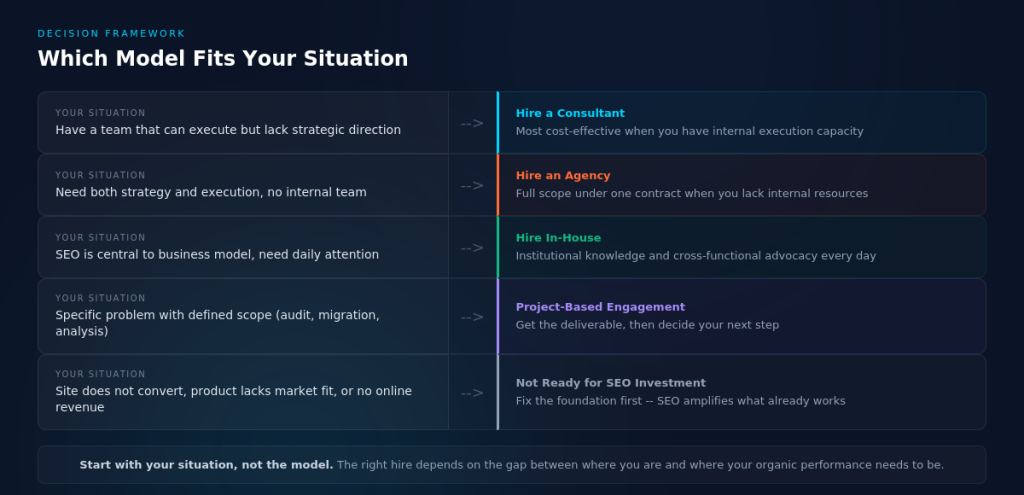
Instead of comparing features, start with your situation. The model that fits depends on what you need right now, not which one sounds best on paper.
You have a team that can execute but lack strategic direction. Hire a consultant. Your developers can make technical changes. Your writers can produce content. What you need is someone to tell them what to prioritize and why. A consultant provides the strategy, the roadmap, and the ongoing oversight. Your team does the work. This is the most cost-effective model when you have internal execution capacity.
You need both strategy and execution and do not have the team to do either. Hire an agency. If you do not have writers, developers, or marketing staff who can implement SEO recommendations, you need a provider that handles the full scope. An agency brings the thinking and the doing under one contract. Be prepared for less direct access to senior strategists, but you gain the execution capacity you lack internally.
You need someone embedded in your organization full-time. Hire in-house. If SEO is central to your business model and you need daily attention, cross-functional collaboration, and deep institutional knowledge, a full-time hire is the right move. This works best for companies with enough SEO volume and complexity to justify a dedicated role. Keep in mind that the total cost of an in-house hire includes salary, benefits, tools, training, and management overhead.
You have a specific problem with a defined scope. Start with a project-based engagement. If you need an SEO audit, a site migration plan, or a competitive analysis, you do not need an ongoing retainer or a full-time hire. Engage a consultant or agency for the specific project, get the deliverable, and decide your next step from there.
You are not sure what you need. Start with diagnosis. If you cannot articulate the problem, you are not ready to choose a model. Engage a consultant for a one-time assessment. A good assessment will tell you what is wrong, what the opportunity looks like, and which engagement model makes sense for your situation.
What Each Model Costs You Beyond the Price
The dollar cost is the most visible expense. It is not the only one. Each model carries hidden costs that affect the total value of the investment.
Management Overhead
An in-house hire requires management: performance reviews, career development, tool procurement, and ongoing training. An agency requires coordination: reviewing deliverables, providing feedback, attending status calls, and ensuring the work aligns with your business goals. A consultant requires the least management overhead because you are working directly with the decision-maker. But a consultant also requires your team to execute, which means managing that internal workload.
Ramp-Up Time
An in-house hire needs three to six months to learn your business, your market, and your competitive landscape before they are operating at full effectiveness. An agency needs one to two months to onboard, audit, and build a strategy. A consultant with relevant experience can often diagnose and begin strategic work within the first two to four weeks because they bring pattern recognition from similar situations.
Opportunity Cost
Every model has an opportunity cost. Choosing a consultant means you pass on execution capacity. Choosing an agency means you may pass on the deepest strategic thinking. Choosing in-house means you pass on the breadth of external perspective. The question is which trade-off you can best afford given your current situation and goals.
The Hybrid Approach
The cleanest version of SEO investment is often a combination, not a single model. The most effective setup for many mid-market and growing companies is a consultant providing strategic direction with an agency or internal team handling execution. The consultant defines what to do and why. The execution team does the work. The consultant reviews the output and adjusts the strategy based on results.
This model gives you senior strategic depth without paying agency overhead for thinking that happens at the account manager level. It gives you execution capacity without requiring your consultant to produce content or make technical changes. And it gives you clear accountability: the consultant owns the strategy, the execution team owns the output.
A variation of this approach is the fractional SEO consultant model, where a senior strategist embeds part-time within your organization, providing consistent strategic guidance without the overhead of a full-time salary.
When None of the Three Is Right Yet
Sometimes the honest answer is that none of these models is the right investment right now. If your website does not convert visitors into customers, SEO will bring more visitors who do not convert. Fix the conversion problem first. If your product has not found market fit, organic traffic will not solve a product problem. If your business does not generate revenue through online channels, SEO consulting, agency services, and in-house hires are all the wrong investment.
SEO amplifies what already works. If the foundation is not in place, the amplification has nothing to work with. The most responsible thing a consultant, agency, or in-house SEO can tell you is when you are not ready for their help. Understanding what SEO consulting is and what it is not can help you make that determination.
Making the Decision
The consultant vs agency vs in-house decision is a business decision, not a preference. It depends on your internal resources, your budget, the complexity of your SEO challenges, and how directly you want senior strategic involvement.
A consultant gives you the most strategic depth per dollar. An agency gives you the most execution capacity. An in-house hire gives you the most institutional knowledge and daily attention. A hybrid approach can give you the best of more than one model.
Start with your situation. Define the problem, assess your resources, and choose the model that addresses the gap between where you are and where your organic performance needs to be. The model that fits your situation is the one that produces the best revenue outcome relative to the total investment, not the one that sounds best in a comparison article written by someone selling one of the three options.