

SaaS SEO is not regular SEO applied to a software company. The subscription business model changes what success looks like, what content matters, how measurement works, and which activities generate the highest return. A strategy built for e-commerce or local business will underperform for SaaS because it is optimizing for the wrong outcomes.
The difference starts with revenue. When a customer converts through organic search on an e-commerce site, the transaction is complete. When a SaaS visitor signs up for a free trial or requests a demo, the revenue has not happened yet. It happens over months or years as that user becomes a paying customer and renews. That distinction changes which organic traffic is valuable, what content deserves investment, and how SEO ROI is measured.
What follows is an explanation of what makes SaaS SEO different than traditional SEO consulting, how the growth model determines the strategy, which content types drive revenue in SaaS, and when SEO is not the right investment.
What Makes SaaS SEO Different
Three characteristics of the SaaS business model fundamentally change how SEO strategy should work.
Revenue is recurring, not transactional. A single organic visitor who converts to a paying customer may generate revenue for years. This means the lifetime value of an organic acquisition matters far more than the value of a single conversion. A keyword that drives 50 trial signups per month at a 20 percent trial-to-paid rate and a $5,000 annual contract value is not a “50 conversions” keyword. It is a $50,000 annual recurring revenue keyword. SEO strategies that optimize for conversion count without understanding contract value and retention are leaving the most important numbers out of the equation.
Sales cycles are longer and involve multiple touches. Especially in B2B SaaS, a buyer may interact with the company across organic search, paid ads, webinars, sales calls, and peer reviews before signing a contract. Organic search often plays the discovery role: the buyer finds the company through a problem-oriented or comparison query, but the deal closes weeks or months later through a different channel. Measuring SEO only by last-touch conversions drastically undervalues its contribution.
The product is the content. SaaS companies have a built-in content advantage that most businesses do not: the product itself generates search-relevant topics. Every feature, integration, use case, and workflow is a potential search query. When a prospect searches for a specific capability, the company that has a dedicated, well-optimized page for that feature has an advantage over the competitor whose feature is buried in a generic product overview.
Product-Led vs Sales-Led: Two Different SEO Strategies
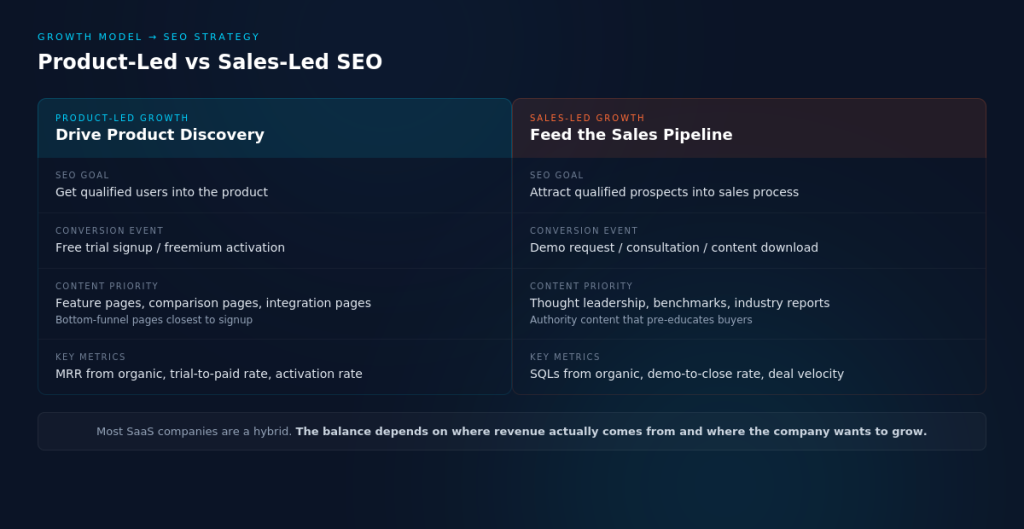
The way a SaaS company acquires customers determines what SEO needs to accomplish. Product-led growth and sales-led growth require fundamentally different content strategies, conversion paths, and measurement approaches.
Product-Led Growth
In a product-led growth model, the product is the primary acquisition and conversion mechanism. Users discover the software, sign up for a free trial or freemium tier, experience the product, and convert to a paid plan based on the value they experience. SEO in this model drives product discovery. The goal is to get qualified users into the product as quickly as possible.
Content priorities in a PLG model lean toward bottom-of-funnel pages that connect directly to the product: feature pages targeting capability queries, comparison pages targeting buyers evaluating alternatives, use case pages targeting specific problems the product solves, and integration pages targeting ecosystem queries. Blog content still has a role, but the highest-value organic pages are the ones that sit closest to a signup or trial start.
Sales-Led Growth
In a sales-led model, organic search feeds the pipeline that a sales team closes. The conversion goal is typically a demo request, consultation, or content download that enters the prospect into a sales sequence. SEO in this model drives lead generation. The goal is to attract qualified prospects and move them into the sales process.
Content priorities shift toward educational content that establishes authority and captures leads at different stages of the buying process: industry reports, benchmark data, and thought leadership content that positions the company as a trusted advisor. The sales team needs the prospect to have already engaged with the brand and understood the problem before the first call. SEO provides that pre-education at scale.
Most SaaS companies are a hybrid. They have self-serve signup paths and sales teams working larger accounts. The SEO strategy needs to serve both motions, which means building content that supports product discovery and pipeline generation simultaneously. The balance depends on where the company’s revenue actually comes from and where it wants to grow.
Content That Moves SaaS Revenue
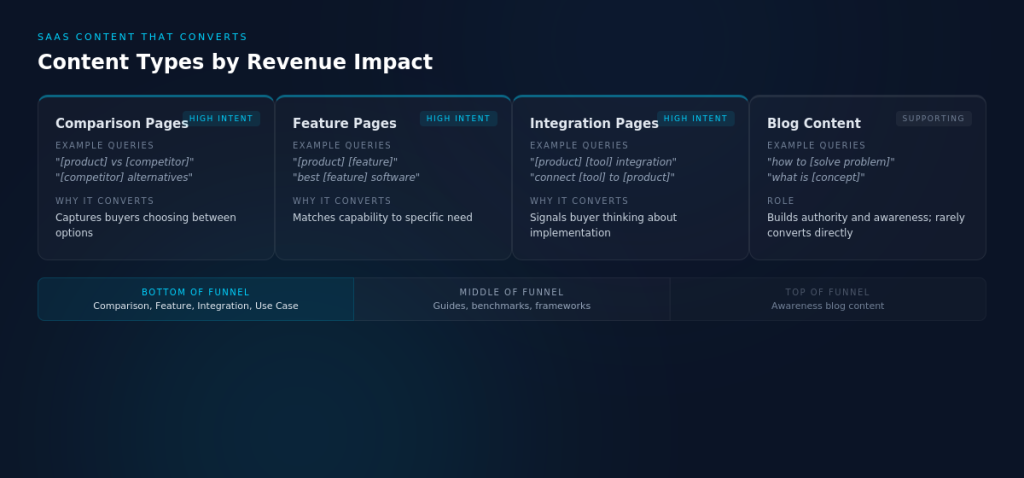
Not all SaaS content is equal from a revenue perspective. The content types that generate the most direct revenue impact for SaaS companies share a common trait: they target people who are actively evaluating solutions, not just researching problems.
Comparison pages. Queries like “[your product] vs [competitor]” and “[competitor] alternatives” capture buyers at the decision stage. These prospects know what they want and are choosing between options. A well-structured comparison page that is honest about trade-offs and clear about differentiation converts at rates that most blog content cannot match. Every SaaS company with a recognizable competitor should have these pages.
Feature pages. Dedicated pages for each major product capability target queries about specific functions. When a buyer searches for a specific feature, the company whose page answers that query directly wins the visit and often the evaluation. These pages also serve the sales team as reference material during the evaluation process.
Integration pages. SaaS buyers care about how software connects to their existing stack. Pages targeting integration-specific queries capture prospects who are already thinking about implementation, which signals high purchase intent. A page for every major integration the product supports creates a network of bottom-funnel entry points.
Use case pages. Pages organized by problem or industry vertical target the way buyers actually search: not by product category, but by the problem they need to solve. A use case page that addresses a specific workflow or business challenge connects the product to the buyer’s reality more effectively than a generic product overview.
Top-of-funnel blog content has its place in a SaaS content strategy, but it is the supporting cast, not the lead. SaaS companies that invest their entire SEO budget in blog posts targeting informational queries build traffic that does not convert. The highest-returning content sits at the bottom of the funnel, where organic visitors are closest to a buying decision.
Measuring SEO in SaaS Terms
Generic SEO measurement tracks traffic, rankings, and conversions. SaaS SEO measurement needs to go further because the metrics that matter to a SaaS business are different from the metrics that matter to an e-commerce store or a local service provider.
The most meaningful SaaS SEO metrics connect organic search to recurring revenue. Monthly recurring revenue influenced by organic search tells you how much of the subscription base came through or was assisted by organic channels. Trial-to-paid conversion rate from organic visitors shows whether organic traffic is attracting qualified users who actually find value in the product. Customer acquisition cost through organic versus paid channels reveals whether SEO is a more efficient acquisition path, which it usually is over time. And churn rate of organic-acquired customers compared to other channels indicates whether SEO is attracting the right customers, not just the most customers.
These metrics require integration between analytics, the product’s trial and conversion tracking, and the CRM or billing system. Setting up this measurement infrastructure is part of the consulting engagement, not an afterthought. A SaaS company that cannot connect organic traffic to recurring revenue cannot measure their return on SEO or make informed decisions about where to invest in SEO.
When SEO Is Not the Right Investment
An honest assessment of SaaS SEO includes acknowledging the situations where it is not the right use of limited resources.
Before product-market fit. If the product is still changing based on customer feedback and the target market is not yet defined, SEO is premature. Building an organic content strategy around a positioning that will shift in six months wastes resources. The priority before product-market fit is direct customer conversations, not scalable acquisition channels.
Category creation. If the company is creating a new category that nobody is searching for yet, SEO cannot drive discovery because there is no search demand to capture. In this situation, demand generation through paid channels, events, and thought leadership needs to come first. SEO becomes valuable once the category has enough search volume to target.
Entirely relationship-driven sales. Some enterprise SaaS products sell exclusively through executive relationships, conferences, and referrals. If the buying process never involves a web search, SEO will not influence it. This is rare, but it exists. The honest recommendation in that situation is to invest elsewhere.
These are not permanent conditions. A company that achieves product-market fit should revisit SEO. A company that builds category awareness will eventually see search demand appear. The point is not that SEO does not work for SaaS. It is that timing matters, and investing too early can look like SEO failed when the real issue was readiness.
SaaS SEO as a Growth Investment
SEO consulting for SaaS companies requires understanding the subscription business model, the growth motion, and the content types that generate recurring revenue. A generic SEO strategy applied to a SaaS company will produce generic results: traffic that does not convert, content that does not connect to the product, and measurement that does not reflect how the business actually works.
The value of a SaaS-focused SEO consultant is not just SEO expertise. It is the ability to translate that expertise into the language and metrics of SaaS: MRR, trial conversion, CAC, churn, and lifetime value. That translation is what connects organic search to the outcomes that SaaS companies measure across every function of the business.