

Most SEO consulting pages describe the same set of activities: keyword research, technical audits, link building, content optimization. Those are tactics. They are important, but they are not a strategy. The difference matters because tactics without strategy produce activity without direction. A business can execute dozens of SEO tactics and still not move revenue because nobody decided which tactics mattered most, in what order, and why.
SEO strategy consulting is the practice of determining which SEO activities will produce the greatest revenue impact for a specific business, prioritizing them in the right sequence, and building a plan that connects every recommendation to a measurable business outcome. The strategy is the thinking that happens before the doing. It is the reason one company sees returns from SEO in six months while another spends a year optimizing pages that were never going to generate revenue.
What follows is an explanation of what SEO strategy actually means, what it includes, why prioritization is the most valuable part, and what causes strategies to fail.
What SEO Strategy Actually Means
A strategy is a plan for allocating limited resources to achieve a specific objective. In SEO, the objective is revenue growth through organic search. The limited resources are time, budget, internal capacity, and attention. The plan determines which activities get those resources and which do not.
Tactics are the individual activities that execute a strategy. Keyword research is a tactic. Writing content is a tactic. Fixing site speed is a tactic. Building links is a tactic. Each one can be done well or poorly, but the quality of execution matters less than whether the tactic was the right one to prioritize in the first place.
A strategy answers three questions that tactics cannot answer on their own. First, what are we trying to achieve with SEO, measured in business terms? Second, given our current position, resources, and competitive landscape, which activities will produce the greatest return? Third, in what sequence should we execute, and what are the dependencies between activities?
Without a strategy, SEO becomes a checklist. The business runs through audit recommendations, publishes content on a schedule, builds some links, and hopes the results follow. Sometimes they do. More often, the results are modest because the checklist was not prioritized by impact. The highest-value opportunities were not identified, so resources were spread evenly across activities that vary dramatically in their potential return.
What an SEO Strategy Includes
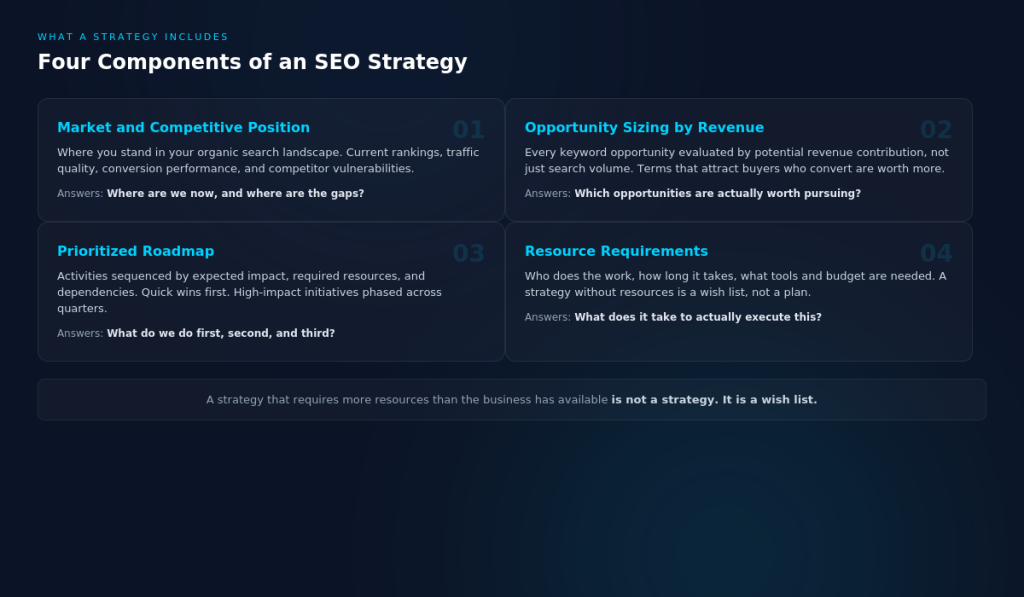
A complete SEO strategy is a document and an ongoing process. The document captures the current state, the target state, and the prioritized path between them. The process ensures the strategy adapts as results come in and market conditions change.
Market and Competitive Position
The strategy starts by understanding where the business stands in its organic search landscape. This includes an analysis of current rankings, traffic quality, and conversion performance. It also includes a thorough competitor analysis that goes beyond identifying who ranks for target terms. The analysis examines what competitors do well, where they are vulnerable, and what content gaps represent genuine opportunities for the business to differentiate.
Opportunity Sizing by Revenue Potential
Not all keyword opportunities are equal. A term with 10,000 monthly searches may generate less revenue than a term with 500 searches if the higher-volume term attracts visitors with no purchase intent. The strategy sizes every opportunity by its potential revenue contribution, not just its search volume. This requires understanding the full conversion path: from search to landing page to engagement to lead or sale. Terms that attract qualified buyers who convert are worth more than terms that attract researchers who leave.
Prioritized Roadmap
The roadmap is the operational core of the strategy. It sequences every recommended activity by expected impact, required resources, and dependencies. Quick wins that require minimal effort go first because they build momentum and demonstrate value. High-impact, high-effort initiatives are phased across quarters with clear milestones. Activities that depend on other work completing first are sequenced accordingly. The roadmap is specific enough to execute against and flexible enough to adjust when results reveal new information.
Resource Requirements
A strategy that requires more resources than the business has available is not a strategy. It is a wish list. The plan must account for who will do the work, how long it will take, what tools and budget are needed, and what internal support is required. If the business needs content written, the strategy specifies how much, at what level of quality, and who will produce it. If technical changes require developer time, the strategy includes that dependency. A realistic resource plan is what separates an actionable strategy from a presentation that sits in a drawer.
Prioritization Is the Strategy
Every business has more SEO opportunities than it has resources to pursue. The consultant who identifies 200 opportunities has not delivered a strategy. They have delivered a list. The consultant who identifies 200 opportunities, evaluates them by revenue potential and effort, and recommends a sequence of 20 priorities for the next two quarters has delivered a strategy.
Prioritization is where the real value of SEO strategy consulting lives. It requires the ability to evaluate each opportunity against multiple criteria simultaneously: potential revenue impact, probability of ranking improvement, resource requirements, competitive difficulty, and strategic alignment with business goals. This evaluation is not mechanical. It requires judgment built from experience across many businesses, markets, and competitive situations.
The most common mistake in SEO planning is treating all recommendations as equally important. When everything is a priority, nothing is a priority. Resources get spread thin. Progress happens across many fronts but decisively on none. A strong strategy accepts that some good ideas will wait because better ideas should go first. That discipline is what produces measurable results within the timelines that businesses actually operate on. This practice also makes it easier to measure the ROI on an SEO campaign.
What Makes a Strategy Fail
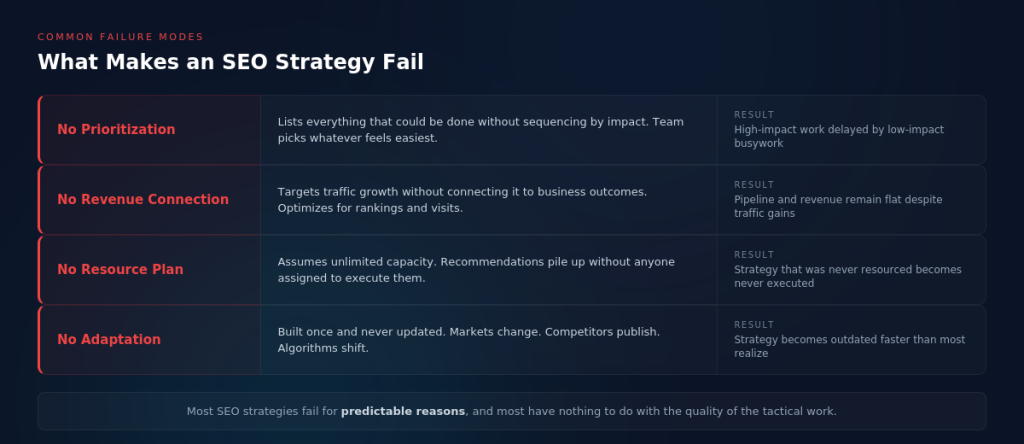
SEO strategies fail for predictable reasons, and most of them have nothing to do with the quality of the tactical work.
No prioritization. The strategy lists everything that could be done without sequencing by impact. The team picks whatever feels easiest or most interesting rather than what matters most. Results are slow because high-impact work gets delayed by low-impact busywork.
No revenue connection. The strategy targets traffic growth without connecting that traffic to business outcomes. The team optimizes for rankings and visits while pipeline and revenue remain flat. This is the most common failure in SEO programs and the hardest to fix because it requires rethinking the entire measurement framework.
No resource plan. The strategy assumes unlimited capacity. Recommendations pile up without anyone assigned to execute them. Months pass. The audit findings are stale. The competitive landscape has shifted. The strategy that was never resourced becomes a strategy that was never executed.
No adaptation mechanism. The strategy was built once and never updated. Markets change. Competitors publish new content. Algorithm updates shift the landscape. A strategy without a regular review and adjustment process becomes outdated faster than most businesses realize.
When Strategy Becomes Ongoing
The initial strategy document sets the direction. But SEO strategy consulting is most valuable as an ongoing engagement, not a one-time deliverable. The first quarter of execution reveals which assumptions were correct and which need adjustment. New data changes the prioritization. Competitive moves create new opportunities or threats. Algorithm updates shift what works and what does not.
A good strategy consultant reviews results quarterly, adjusts priorities based on what the data shows, and keeps the strategy aligned with the business as both evolve. This is especially important as the search landscape continues to change with AI-powered search, new content formats, and shifting user behavior. The strategy that worked twelve months ago may no longer reflect how buyers find and evaluate solutions today.
Strategy Before Tactics
SEO strategy consulting is not a different service from SEO consulting. It is the part of SEO consulting that determines whether all the other parts produce results. Without strategy, tactics are guesswork. Without prioritization, effort is scattered. Without revenue alignment, success is measured in metrics that do not matter to the business.
The value of an SEO strategy consultant is not knowing every tactic. It is knowing which tactics matter for your specific business, in what order, and why. That judgment is what separates a productive SEO program from one that generates reports without generating revenue.