

SEO consulting is a professional advisory service in which an external specialist analyzes, strategizes, and advises on search engine optimization to improve a business’s revenue from organic search. That definition matters because most definitions of SEO consulting stop at “improving rankings” or “increasing traffic.” Rankings and traffic are indicators. Revenue is the outcome. The distinction changes how the entire service workswhat gets prioritized, what gets measured, and what “success” means at the end of an engagement.
An SEO consultant evaluates your site’s technical health, content quality, and competitive positioning, then builds a strategy around the activities most likely to generate business results. This page covers what an SEO consultant actually does, when consulting makes sense and when it does not, what SEO consulting cannot fix, how consultants differ from agencies and in-house teams, and how to evaluate whether the investment is worth it for your business.
What an SEO Consultant Actually Does
An SEO consultant provides strategic guidance on organic searchfrom initial assessment through ongoing optimizationwith the goal of connecting search visibility to measurable business outcomes.
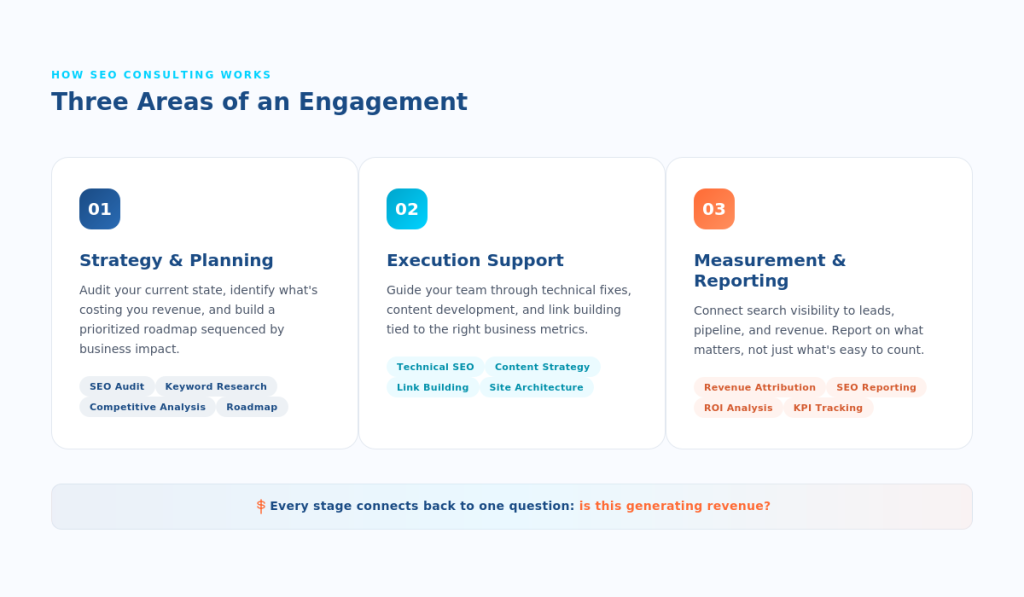
The work breaks into three areas: planning, execution oversight, and measurement.
Strategy and Planning
The engagement starts with an SEO auditan analysis of your site’s technical foundation, content depth, keyword positioning, backlink profile, and competitive landscape. The audit identifies what is working, what is broken, and what is costing you revenue. From there, the consultant builds an SEO strategya prioritized plan that sequences improvements by business impact, not by what is easiest to implement. The strategy includes target keywords, content gaps, technical fixes, and internal linking architecture, organized into a roadmap your team can execute against.
Technical and Content Execution
Execution varies by engagement model. Some businesses need the consultant to advise while their internal team implements. Others need the consultant embedded in the workreviewing code changes, writing content briefs, coordinating with developers, and managing link building campaigns. The scope depends on your team’s capacity and the complexity of the project. Technical SEO covers crawlability, indexation, page speed, mobile experience, and site architecture. Content strategy covers topic selection, keyword targeting, content structure, and publication planning. Both feed revenue outcomes when tied to the right business metrics.
Measurement and Reporting
SEO consulting without measurement is guesswork. Every engagement defines success criteria before work beginsand those criteria should include revenue metrics, not just traffic volume. Organic sessions and keyword rankings matter as diagnostic signals. Revenue attributed to organic search matters as the outcome that determines whether the engagement produced a return. A consultant who reports only on traffic and rankings is describing the weather. A consultant who connects those signals to leads, pipeline, and revenue is telling you whether to bring an umbrella or cancel the trip.
Understanding how SEO consulting works in detailthe stages, deliverables, and timelineshelps set realistic expectations before an engagement begins.
When You Need SEO Consulting (And When You Don’t)
SEO consulting makes sense when there is a clear gap between where your organic search performance is and where it needs to beand when that gap is costing your business revenue.
Specific signals that indicate a need for SEO consulting include organic traffic that does not convert, declining search visibility after a Google algorithm update, a website redesign or migration with no SEO planning, a content library that generates impressions but not leads, and competitive pressure from businesses that rank above you for your most valuable keywords.
SEO consulting does not make sense in every situation. If your business has no product-market fit, an SEO consultant cannot manufacture demand that does not exist. If your sales process is brokenleads come in but never closethat is a sales problem, not an SEO problem. If your website gets 50 visitors a month and your total addressable market searches 20 times a month for your core terms, the math does not support a consulting engagement. Knowing when SEO consulting is not the answer is as useful as knowing when it is.
When the signals are there, the next step is understanding how to hire an SEO consultant who measures success by business outcomes, not activity reports.
What SEO Consulting Can’t Fix
SEO consulting is not a universal business solution. Knowing its limits upfront prevents wasted budget and misaligned expectations.
SEO consulting cannot fix a weak product. If customers try your product and leave, no amount of organic traffic changes the underlying problem. SEO consulting cannot fix a broken business model. If your unit economics do not work, more visitors make the problem worse, not better. SEO consulting cannot guarantee a specific ranking position. Anyone who promises page one for a specific keyword is selling certainty where none existsGoogle’s algorithm weighs hundreds of factors, and no consultant controls them all.
SEO consulting cannot produce meaningful results in two weeks. Organic search is a compounding channel. The timeline from first audit to measurable revenue impact typically runs three to six months, depending on your site’s current state, competitive intensity, and the scope of work required. SEO consulting also cannot replace a marketing strategy. SEO is one channel within a broader go-to-market approach. A consultant who treats organic search as the only channel worth investing in is missing the larger picture.
These limitations are not weaknesses. They are boundaries that define where SEO consulting delivers value and where it does not. A deeper look at what SEO consulting can’t fix covers each limitation in detail with practical guidance on what to do instead.
SEO Consultant vs. Agency vs. In-House
The first structural decision is not whether to invest in SEO, but which model fits your situation: a consultant, an agency, or an in-house hire.
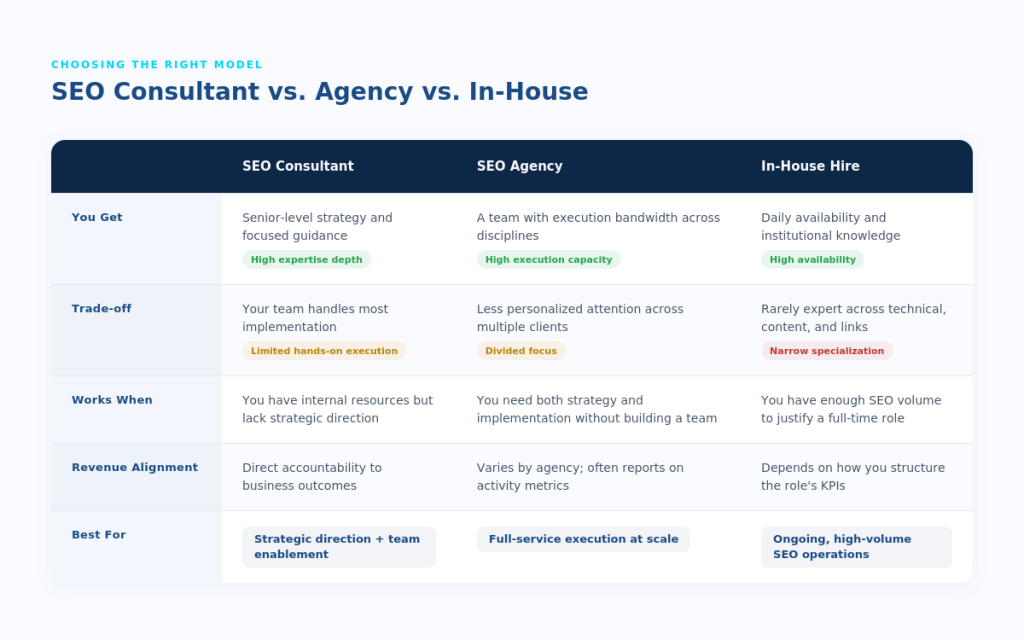
An SEO consultant provides focused, senior-level attention on strategy and guidance. The trade-off is execution capacityconsultants advise and oversee, but your team handles most of the implementation. This model works for businesses that have internal resources but lack strategic direction.
An SEO agency provides a broader team with execution bandwidth. The trade-off is personalizationagencies serve multiple clients, and the strategist who sold you may not be the person managing your account day to day. This model works for businesses that need both strategy and hands-on execution without building an internal team.
An in-house SEO hire provides daily availability and institutional knowledge. The trade-off is depthone person rarely covers technical SEO, content strategy, and link building at an expert level across all three. This model works for businesses with enough SEO volume to justify a full-time role.
The right choice depends on your budget, the complexity of the work, and how much hands-on execution you need versus strategic direction. A detailed comparison of the SEO consultant vs. agency trade-offs helps clarify which model fits.
How to Know If SEO Consulting Is Worth the Investment
The evaluation is straightforward: does the expected revenue from organic search improvement justify the cost of the engagement?
Start with what you know. What is your current organic traffic? What percentage converts to leads or sales? What is the average value of a conversion? If an SEO consultant can increase qualified organic traffic by 30% over six months, and your conversion rate and average deal size hold, what does that revenue look like against the cost of the engagement?
Measuring SEO ROI requires connecting organic search data to revenue outcomesnot just tracking keyword positions. The businesses that get the most from SEO consulting are the ones that define “worth it” in revenue terms before the work begins.
SEO consulting pricing varies by model and scope, but the cost question only matters in the context of return. A $5,000 monthly retainer that generates $50,000 in attributable revenue is not expensive.
The Short Answer
SEO consulting is professional advisory work focused on improving your business’s revenue from organic search. A good consultant audits what is broken, builds a strategy around what drives results, measures the work against outcomes that matter, and tells you honestly when SEO consulting is not the right solution for the problem you are trying to solve. That combination of expertise, transparency, and revenue alignment is what separates a real consulting engagement from an expensive traffic report.
If organic search should be driving more business than it currently does, a consultation is the first step. The conversation is free.